

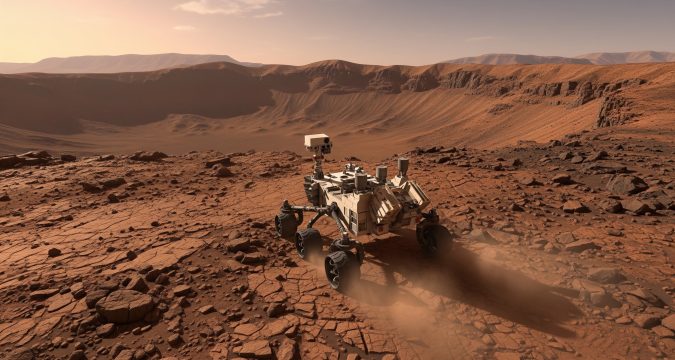
Controlling a Rover on Mars would be like driving a car down a road with a 20-minute delay after every move. Doesn’t sound that great, right?
Due to Mars’ 140 million miles distance from Earth. When you say “turn left,” it doesn’t happen immediately. Mars rovers can’t execute commands in real time. They can’t use “turn left” instructions, because a command may take a long time to arrive. Mars rovers don’t operate like cars; they move autonomously by following pre-determined instructions. NASA has used remote-control “drivers” for decades to generate fully autonomous “driving” instructions for rovers that don’t include “turn left” commands.
But now, something big has changed.
The Rover That Drove Itself
In December 2025, NASA’s Perseverance rover did something that no other spacecraft has ever done. It has become the first to complete two fully autonomous drives on Mars. There were no human route planners nor manual mapping: just the AI, the terrain data, and a lot of trust. The drives took place on December 8 and December 10. On the first day, Perseverance drove 689 feet, and on the second day, 807 feet. That is almost 1,500 feet total on the rocky rim of Jezero Crater.
JPL ran the whole project. The team worked with AI company Anthropic and used Claude AI models to pull it off.
How Did the AI Plan the Route?
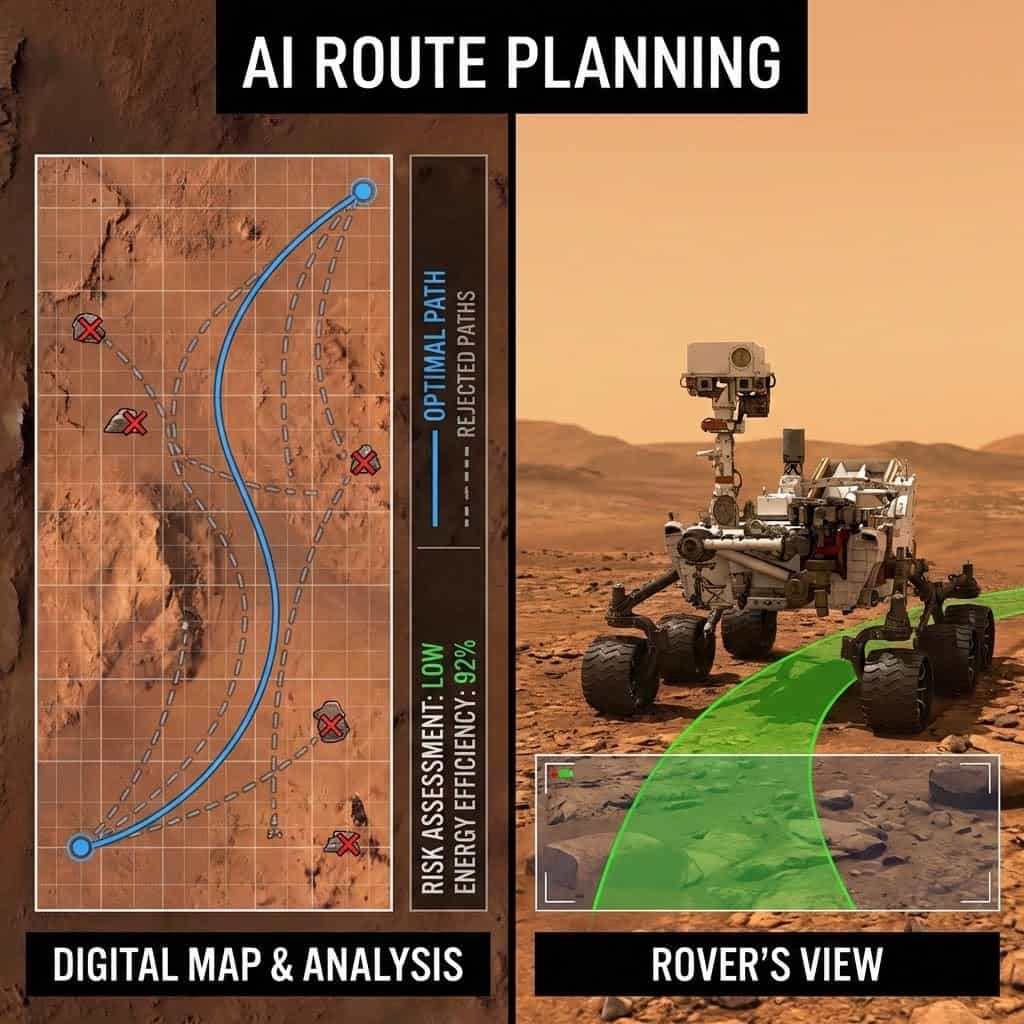
The AI looked at the same images and data that human planners normally use. It studied detailed photos from NASA’s Mars Reconnaissance Orbiter high above. It also checked slope data pulled from digital terrain maps.
From all that, it did three key things:
- It spotted rocks, steep slopes, and dangerous boulder fields
- It found safer zones with flat ground and solid bedrock
- It laid out a full path with waypoints — set spots where the rover pauses and picks up fresh instructions
Waypoints act like points of interest on a road trip. The rover gets to one, checks its location, then heads to the next one. You can consider it similar to following breadcrumbs through a very rocky, red desert.
Before any of this was sent to Mars, the team simulated the full plan with a digital version of Perseverance on Earth. They analyzed over 500,000 data points. Only then were the commands sent to the rover.
Why This Is a Big Deal
The further a spacecraft travels from Earth, the more difficult it becomes to take over control from a human. Deep-space missions will face such long delays before human control becomes possible.
AI fixes that gap. A smart rover can scan its surroundings, pick its own path, and keep rolling — no waiting hours for a human to respond. More ground gets covered. More science gets done.
Vandi Verma, a space scientist at JPL, said it clearly: “We are moving towards a day where generative AI and other smart tools will help our surface rovers handle kilometer-scale drives… and flag interesting surface features for our science team.”
That day kicked off in December 2025.
So, Can AI Drive a Spacecraft?
Yes. It already has. Perseverance showed that AI can safely handle alien terrain on its own. This is just the start. Rovers and probes may soon run full missions with very little human help. Space exploration just got a whole lot more exciting.

