

Category: Astronomy Basics
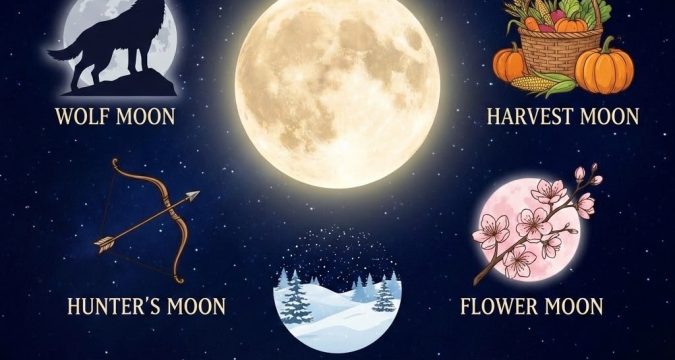
Full Moon Names Explained (Wolf Moon, Harvest Moon, etc.)
Have you ever heard someone say “the Wolf Moon is rising” and had no clue what that meant? If that is the case, you are not alone in that. Full moons have been given special names for thousands of years. And each name hides a special story about nature, the seasons, and also life in a very different time.
Most of these names were given by Native American tribes. They used the moon like a clock and a calendar. So the night sky was read the way a schedule is read. Each full moon was linked to a shift in nature. Planting was timed. Hunting was planned. Cold weather was prepared for. Later, the names were adopted by Colonial Americans. Now they are heard as part of normal sky talk. And if you have heard them, the same old system has been passed on to you.
Here’s a look at each month’s full moon name and what it actually means:
January — Wolf Moon
During midwinter, hungry wolves were heard in the distance. Food was hard to find. So their calls were sent across empty fields. That is how January’s moon was named, and you can see the scene without much effort.
February — Snow Moon
Throughout most of February, heavy snow fell across North America. The moon was named after what was covering everything. In some areas, the storm moon name was used. The hunger moon name was used too. If you have been caught in a long winter, you and I know how those names were earned.
March — Worm Moon
When the ground began to thaw, worm trails were left in the soil. This sign was noticed year after year by Native Americans. It was treated as a marker that winter was ending—a small detail, yet it was trusted.
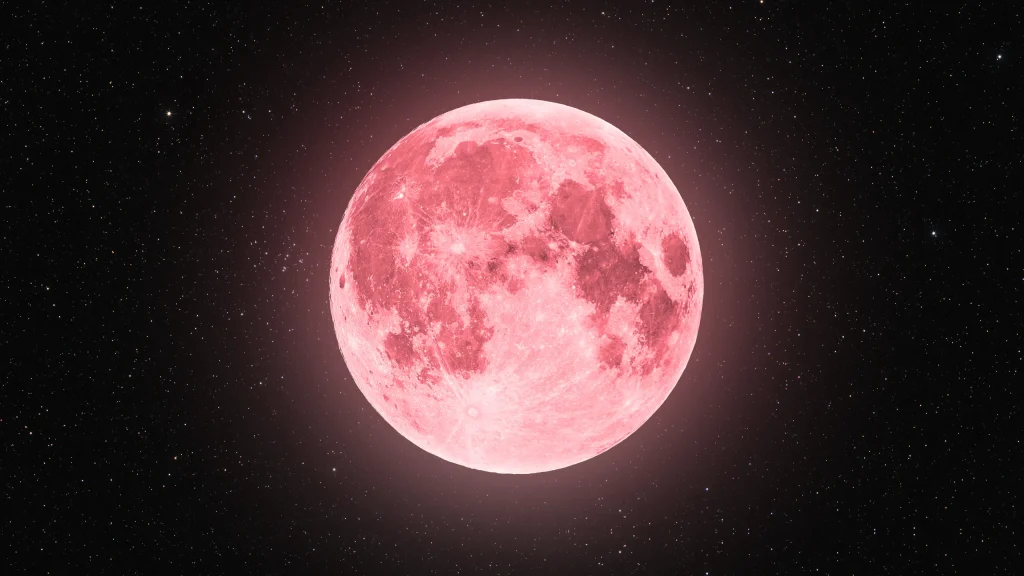
April — Pink Moon
The moon is not painted pink. The name was taken from a small wildflower that blooms early in spring. It is a small joke in the name. Still, the timing was useful, so the name stayed.
May — Flower Moon
By May, flowers are seen in many places. So the name was given. Some tribes also called it the corn planting moon.
June — Strawberry Moon
Strawberry season kicked off in June across North America. Europeans called it the rose moon instead. Both names feel right for early summer.
July — Buck Moon
Male deer start growing back their antlers in July. That yearly cycle gave this moon its name. Some also call it the thunder moon, after summer storms.
August — Sturgeon Moon
Fishing tribes noticed sturgeon appeared in big numbers in August. The moon got named after the catch of the season—simple logic.
September — Corn Moon / Harvest Moon
By September, crops were ready for harvest. The moon rose bright and early. That extra light was used for work after dark. When this moon is set closest to the fall equinox, the name Harvest Moon is used. It was kept because it fit.
October — Hunter’s Moon

Bare fields after harvest left deer and fox with nowhere to hide. Hunters used the bright October moon to track prey deep into the night.
November — Beaver Moon:
Beavers were busy in November. Some say tribes set traps during this time. Others say beavers rushed to build their winter dams. Either way, beavers were clearly having a hectic month.
December — Cold Moon
Winter arrives. Nights stretch long. The name says it all.
Now what about the Blue Moon? Every two and a half years, you will notice that an extra full moon shows up in the calendar. That thirteenth moon earned the nickname “blue moon.” Nothing to do with color — it’s just a rare extra one that sneaks into the year.
These names are more than fun facts. They show how closely people once watched the sky — no phone apps, no weather forecasts, just the moon telling them what came next.
Habitable Zone Explained: What “Goldilocks Planet” Really Means
You probably must have heard about the story of Goldilocks and the Three Bears. One bowl of porridge was too hot. One was too cold. And one was just right. Scientists borrowed that exact idea when they started searching for planets that could hold life.
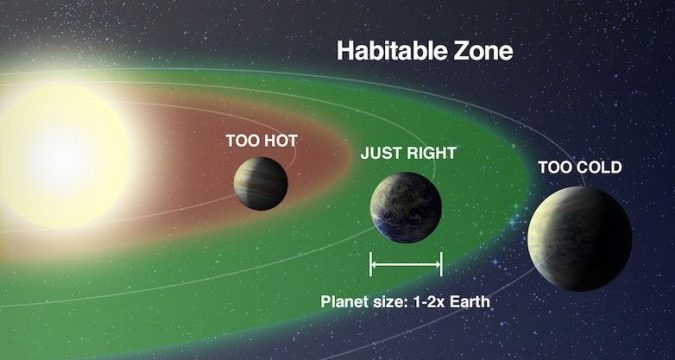
That “just right” band around a star is called the habitable zone. It is also called the Goldilocks zone by some people. The term was first used by Chinese astrophysicist Su Shu Huang in 1959. A region around a star is being described where temperatures allow liquid water to stay on a planet’s surface.
Why Does Liquid Water Matter So Much?
Every known living thing on Earth needs water. Carbon-based life, as we know it, is not sustained without it. So, liquid water is used by scientists as the primary indicator when searching for life on other planets. And when you hear the word “habitable,” know that water is often what is being pointed to.
If it’s too close to a star, the planet gets scorched. Venus is a good example because its surface often hits around 864°F. And that is way too hot. And it is too far away, and the planet freezes into an ice solid. A perfect example is Mars, which averages around -85°F. Any amount of water there turns to ice. But some planets are in the sweet spot. A perfect example is Earth. Here, you will get conditions like liquid oceans, rivers, rain, and life teeming everywhere.
Where Is the Zone, Exactly? The star sets the size and place of the habitable zone.
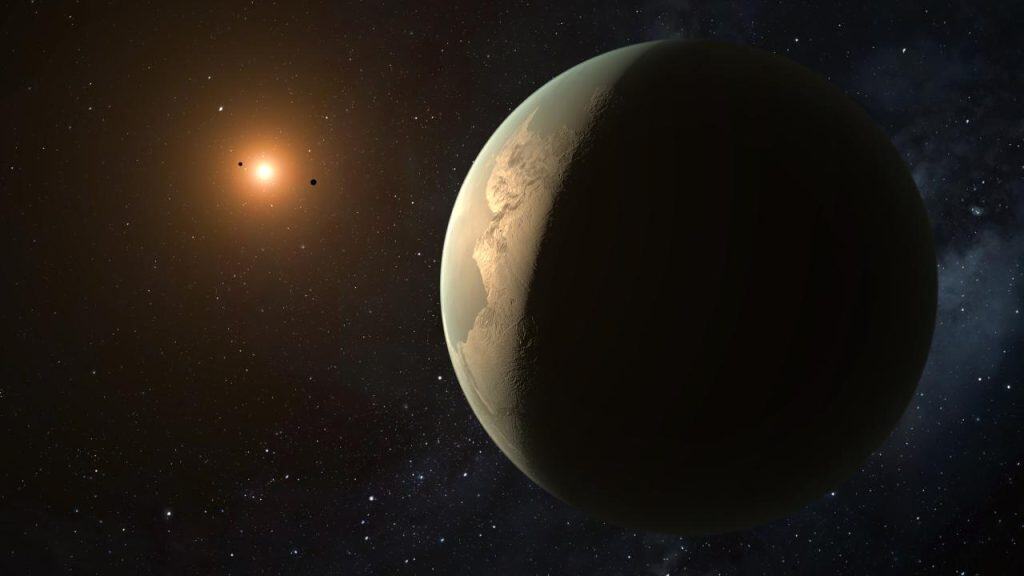
The size and place of the habitable zone are set by the star. A bigger and hotter star is given a wider zone. A smaller, cooler star is given a tighter orbit. Our Sun, on the other hand, is placed in the middle range. It is neither too big nor too small. And so the habitable zone around it is placed roughly between Venus’s and Mars’s orbits. And Earth is set right in the middle of it.
At the inner edge of the zone, a runaway greenhouse effect is triggered. Venus is used as the proof. Its oceans were boiled away billions of years ago. The planet is now kept like a pressure cooker at 464°C. At the outer edge, atmospheric CO2 has started to freeze. The greenhouse effect weakens, and temperatures drop rapidly.
Being in the Zone Doesn’t Guarantee Life
A planet can sit right in the habitable zone and still be totally lifeless. Mars is at the outer edge of our planet. But it is not perfect as it has ice. So we can all assume that it may have had oceans long ago. But nothing lives on its surface as of today. This is all we could know by now.
Scientists now look at a much bigger picture. A planet also needs:
- A stable atmosphere to trap heat
- A magnetic field to block harmful radiation from the star
- Plate tectonics cycles nutrients through the crust
- The right size – too small, and the atmosphere floats away into space
Some researchers also study the “photosynthetic habitable zone.” It means the planet should receive the right kind of light to support life. An astronomer named Cassandra Hall proposed this idea in 2023. It goes beyond just asking “Is there water?”
So Is Earth Actually Rare?
That’s the big debate. Some scientists say Earth met an incredibly long list of lucky requirements, including the right star, a large moon to stabilize our axial tilt, a strong magnetic field, and plate tectonics. All of these lining up together for billions of years might be very rare across the universe.
But others say the universe is enormous. They have theories that there are probably billions of Earth-like planets out there. We just haven’t found them yet.
Actually, the search keeps going. Every planet found inside a habitable zone brings us one step closer to answering the biggest question of all — are we alone?

The Kuiper Belt vs Oort Cloud: Where Comets Come From
Many odd objects are hidden in space. Out beyond Neptune, two giant regions filled with icy rocks are spread through the dark. By most people, they are not often discussed. They are known as the Kuiper Belt and the Oort Cloud. From both regions, comets are sent inward toward the sun. But the two places are shaped very differently. So the Kuiper belt vs Oort cloud comparison will be made simple for you here.
What Is the Kuiper Belt?
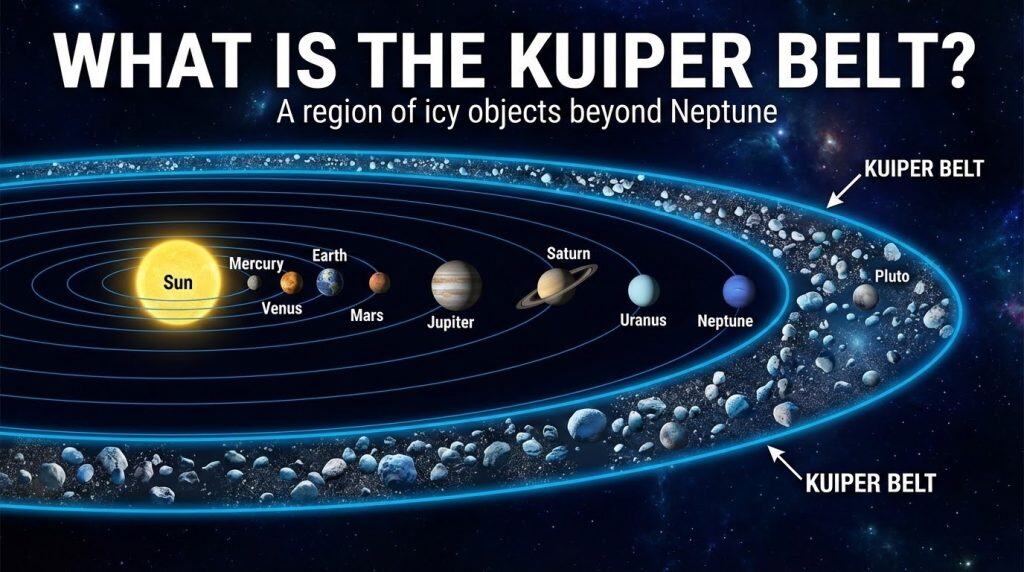
The Kuiper Belt can be pictured as a giant donut around the outer edge of our solar system. It is found just past Neptune at about 30 AU from the sun. By one AU, the distance from Earth to the sun is about 93 million miles. From there, the belt extends to about 1,000 AU. A huge stretch of cold and empty space is included in that span.
Pluto is found here. Yes, that much-loved demoted planet is placed in the Kuiper Belt. The same region is shared by other dwarf planets, such as Eris, as well as by many icy and rocky objects.
The belt has two main sections:
- The inner region is denser and more stable. Orbits here are steady and calm.
- The outer region, called the scattered disk, is chaotic. Objects zoom around in wild, erratic paths.
NASA’s New Horizons spacecraft flew through this region and found something strange. There was way more dust out there than models expected. This hints that the Kuiper Belt might stretch even farther — possibly out to 80 AU. Some scientists even wonder if there’s a second belt hiding beyond that. Wild, right?
Short-Period Comets Start Here
The Kuiper Belt is recognized as the source of short-period comets. These are comets that are sent around the sun in less than 200 years. Halley’s Comet is a well-known case. It is brought back near Earth about every 75 years. You can plan your whole life around Halley’s visits and still catch it twice if you’re lucky.
Neptune’s gravity is used like a giant kick. These icy bodies are knocked out of the belt and sent inward. Then, they take a long route through the solar system. That is how bright, glowing streaks become visible in the night sky. We see the flash. The long trip behind it is easy to miss.
What Is the Oort Cloud?
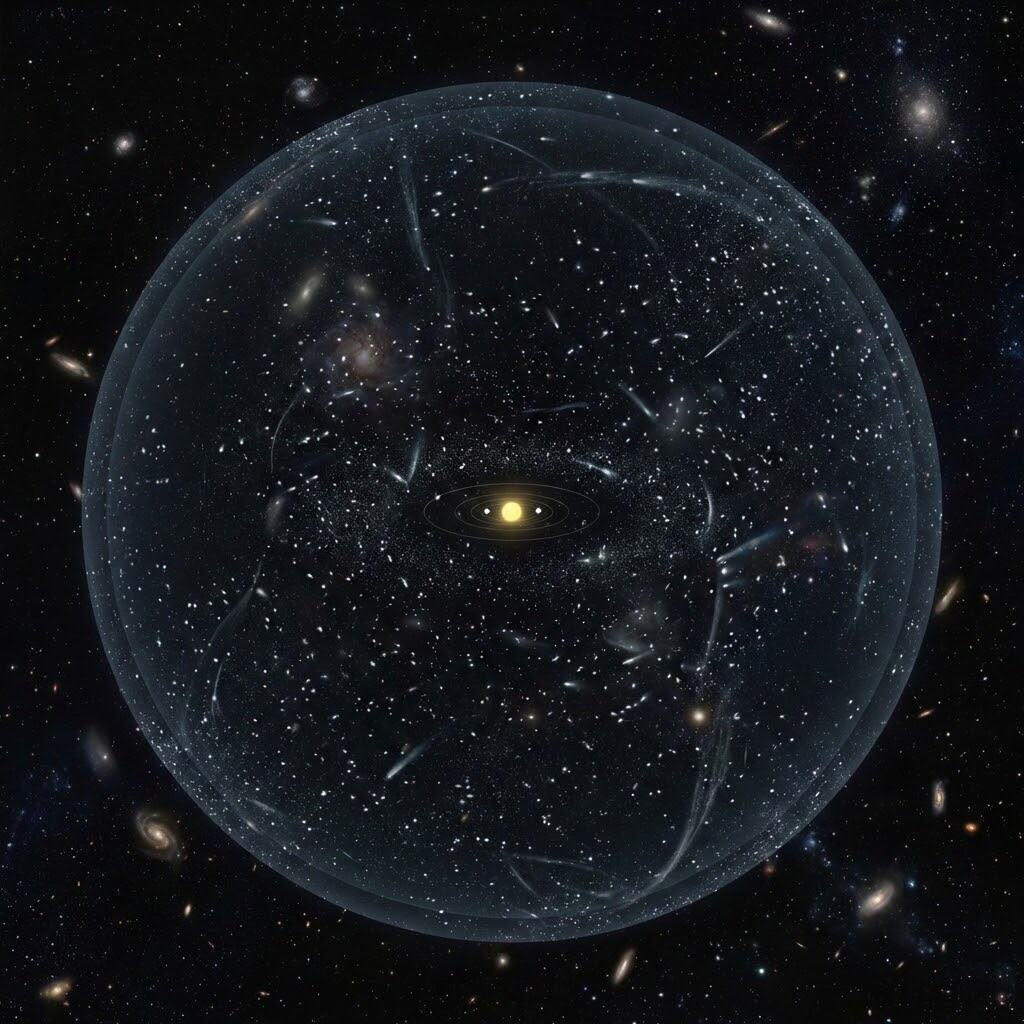
This is where the scale of space is truly felt. The Oort Cloud is placed far beyond the Kuiper Belt. In fact, it is set much farther out than most of us first expect. It is estimated to be at a distance of about 2,000 AU to 100,000 AU from the sun. The closest star to us is about 268,000 AU away. So the Oort Cloud is believed to stretch almost halfway to that star. That distance is hard to take in.
The Kuiper Belt is flat like a pancake. The Oort Cloud is a giant sphere. It wraps around our entire solar system like a bubble. The same flat plane used by the planets is not followed there. Instead, a spread in all directions is believed to occur. Up, down, and side to side—all of it.
There is one limit, though: the Oort Cloud has never been viewed directly. It is still treated as a theory and not a proven place. We’ve spotted the comets it sends our way, but the cloud itself? Too far. Too small. Too dim for current tools to detect.
Kuiper Belt vs Oort Cloud: The Key Differences
Here’s a quick side-by-side look at the Kuiper Belt vs. the Oort Cloud:
| Feature | Kuiper Belt | Oort Cloud |
| Shape | Flat donut | Giant sphere |
| Distance from Sun | 30 to 1,000 AU | 2,000 to 100,000 AU |
| Comet type | Short-period | Long-period |
| Seen directly? | Yes | No |
| Part of solar system? | Yes | No |
The Oort Cloud floats in interstellar space. It lies entirely outside our solar system. The Milky Way’s own gravity holds it loosely in place — like a giant cosmic safety net. Long-period comets are sent from here. These comets are given more than 200 years to orbit the sun. For some of them, thousands of years are needed for just one trip around it.
The Big Picture
Both regions are seen as leftovers from the time our solar system was formed billions of years ago. Chunks of ice and rock were thrown to the far edges of space by giant planets like Jupiter and Neptune. Over time, those chunks evolved into the belts and clouds studied today.
The next time a comet is seen blazing across the sky, its origin will be known to you. The Kuiper Belt will have sent it your way, or the Oort Cloud will have sent it out on a very long journey. And when that happens, a small space story will be carried with it for all of us to enjoy.

