

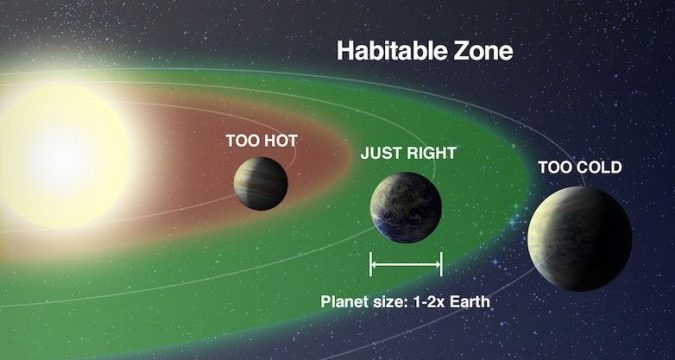
You probably must have heard about the story of Goldilocks and the Three Bears. One bowl of porridge was too hot. One was too cold. And one was just right. Scientists borrowed that exact idea when they started searching for planets that could hold life.
That “just right” band around a star is called the habitable zone. It is also called the Goldilocks zone by some people. The term was first used by Chinese astrophysicist Su Shu Huang in 1959. A region around a star is being described where temperatures allow liquid water to stay on a planet’s surface.
Why Does Liquid Water Matter So Much?
Every known living thing on Earth needs water. Carbon-based life, as we know it, is not sustained without it. So, liquid water is used by scientists as the primary indicator when searching for life on other planets. And when you hear the word “habitable,” know that water is often what is being pointed to.
If it’s too close to a star, the planet gets scorched. Venus is a good example because its surface often hits around 864°F. And that is way too hot. And it is too far away, and the planet freezes into an ice solid. A perfect example is Mars, which averages around -85°F. Any amount of water there turns to ice. But some planets are in the sweet spot. A perfect example is Earth. Here, you will get conditions like liquid oceans, rivers, rain, and life teeming everywhere.
Where Is the Zone, Exactly? The star sets the size and place of the habitable zone.
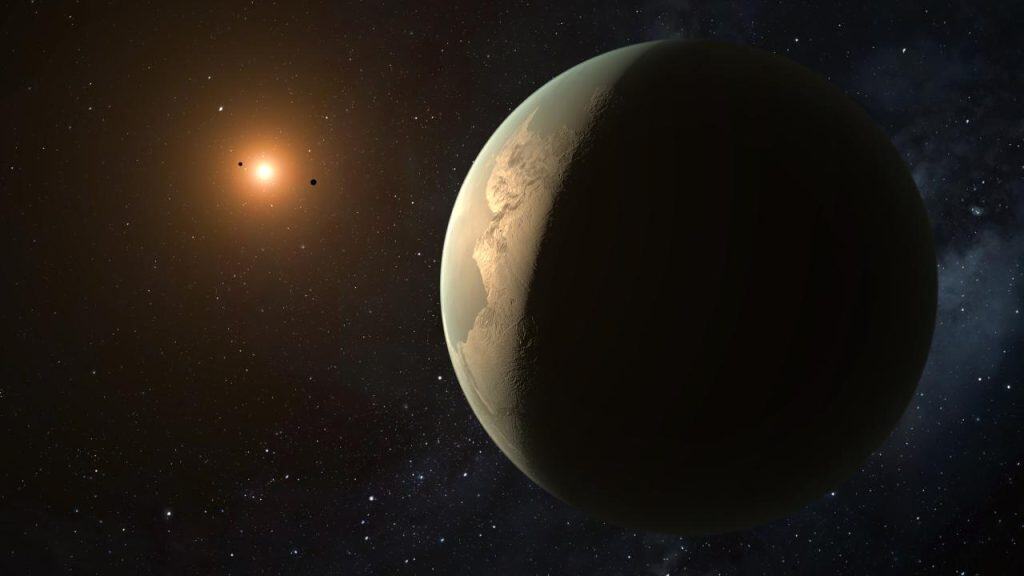
The size and place of the habitable zone are set by the star. A bigger and hotter star is given a wider zone. A smaller, cooler star is given a tighter orbit. Our Sun, on the other hand, is placed in the middle range. It is neither too big nor too small. And so the habitable zone around it is placed roughly between Venus’s and Mars’s orbits. And Earth is set right in the middle of it.
At the inner edge of the zone, a runaway greenhouse effect is triggered. Venus is used as the proof. Its oceans were boiled away billions of years ago. The planet is now kept like a pressure cooker at 464°C. At the outer edge, atmospheric CO2 has started to freeze. The greenhouse effect weakens, and temperatures drop rapidly.
Being in the Zone Doesn’t Guarantee Life
A planet can sit right in the habitable zone and still be totally lifeless. Mars is at the outer edge of our planet. But it is not perfect as it has ice. So we can all assume that it may have had oceans long ago. But nothing lives on its surface as of today. This is all we could know by now.
Scientists now look at a much bigger picture. A planet also needs:
- A stable atmosphere to trap heat
- A magnetic field to block harmful radiation from the star
- Plate tectonics cycles nutrients through the crust
- The right size – too small, and the atmosphere floats away into space
Some researchers also study the “photosynthetic habitable zone.” It means the planet should receive the right kind of light to support life. An astronomer named Cassandra Hall proposed this idea in 2023. It goes beyond just asking “Is there water?”
So Is Earth Actually Rare?
That’s the big debate. Some scientists say Earth met an incredibly long list of lucky requirements, including the right star, a large moon to stabilize our axial tilt, a strong magnetic field, and plate tectonics. All of these lining up together for billions of years might be very rare across the universe.
But others say the universe is enormous. They have theories that there are probably billions of Earth-like planets out there. We just haven’t found them yet.
Actually, the search keeps going. Every planet found inside a habitable zone brings us one step closer to answering the biggest question of all — are we alone?

