


Many odd objects are hidden in space. Out beyond Neptune, two giant regions filled with icy rocks are spread through the dark. By most people, they are not often discussed. They are known as the Kuiper Belt and the Oort Cloud. From both regions, comets are sent inward toward the sun. But the two places are shaped very differently. So the Kuiper belt vs Oort cloud comparison will be made simple for you here.
What Is the Kuiper Belt?
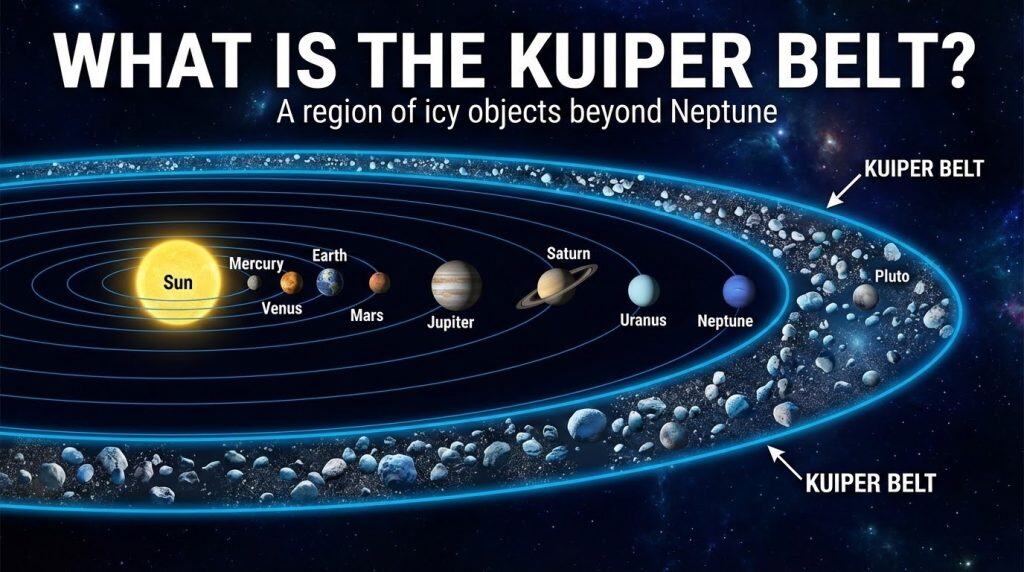
The Kuiper Belt can be pictured as a giant donut around the outer edge of our solar system. It is found just past Neptune at about 30 AU from the sun. By one AU, the distance from Earth to the sun is about 93 million miles. From there, the belt extends to about 1,000 AU. A huge stretch of cold and empty space is included in that span.
Pluto is found here. Yes, that much-loved demoted planet is placed in the Kuiper Belt. The same region is shared by other dwarf planets, such as Eris, as well as by many icy and rocky objects.
The belt has two main sections:
- The inner region is denser and more stable. Orbits here are steady and calm.
- The outer region, called the scattered disk, is chaotic. Objects zoom around in wild, erratic paths.
NASA’s New Horizons spacecraft flew through this region and found something strange. There was way more dust out there than models expected. This hints that the Kuiper Belt might stretch even farther — possibly out to 80 AU. Some scientists even wonder if there’s a second belt hiding beyond that. Wild, right?
Short-Period Comets Start Here
The Kuiper Belt is recognized as the source of short-period comets. These are comets that are sent around the sun in less than 200 years. Halley’s Comet is a well-known case. It is brought back near Earth about every 75 years. You can plan your whole life around Halley’s visits and still catch it twice if you’re lucky.
Neptune’s gravity is used like a giant kick. These icy bodies are knocked out of the belt and sent inward. Then, they take a long route through the solar system. That is how bright, glowing streaks become visible in the night sky. We see the flash. The long trip behind it is easy to miss.
What Is the Oort Cloud?
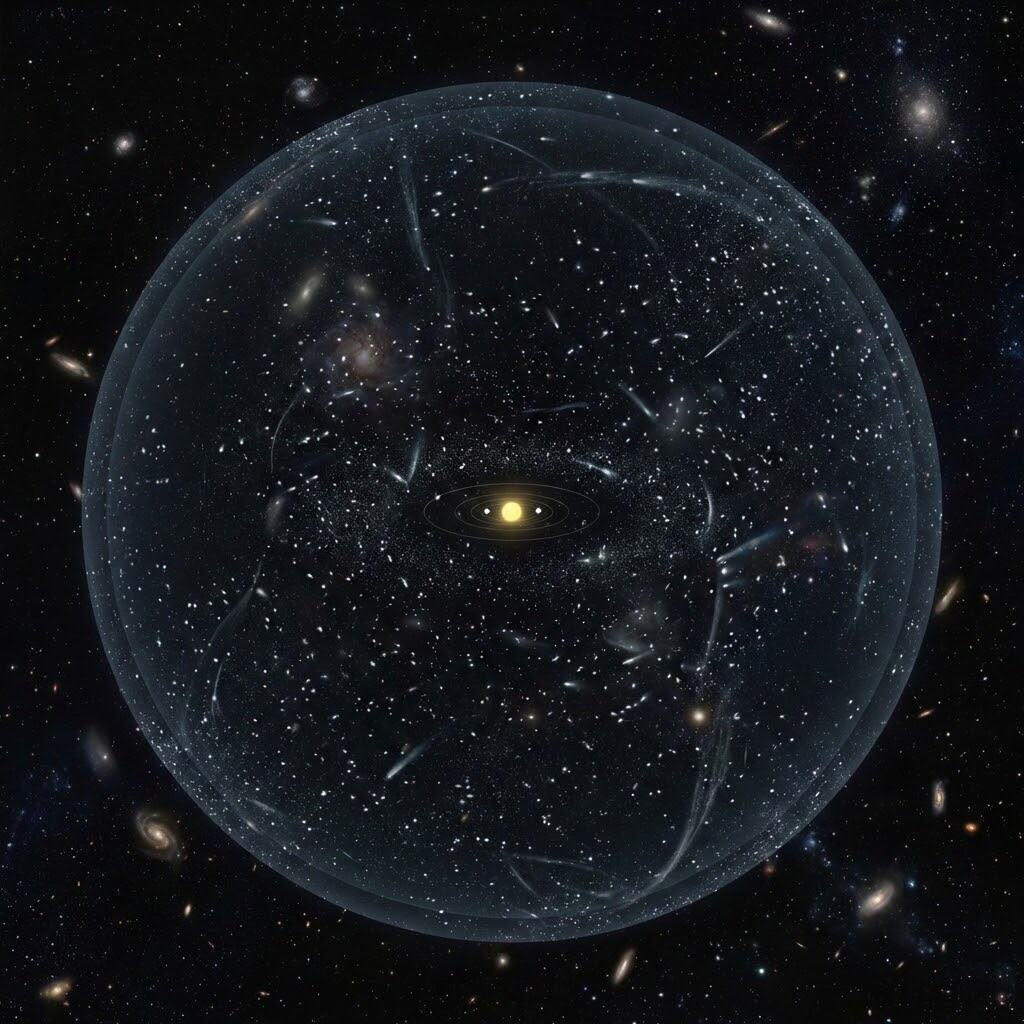
This is where the scale of space is truly felt. The Oort Cloud is placed far beyond the Kuiper Belt. In fact, it is set much farther out than most of us first expect. It is estimated to be at a distance of about 2,000 AU to 100,000 AU from the sun. The closest star to us is about 268,000 AU away. So the Oort Cloud is believed to stretch almost halfway to that star. That distance is hard to take in.
The Kuiper Belt is flat like a pancake. The Oort Cloud is a giant sphere. It wraps around our entire solar system like a bubble. The same flat plane used by the planets is not followed there. Instead, a spread in all directions is believed to occur. Up, down, and side to side—all of it.
There is one limit, though: the Oort Cloud has never been viewed directly. It is still treated as a theory and not a proven place. We’ve spotted the comets it sends our way, but the cloud itself? Too far. Too small. Too dim for current tools to detect.
Kuiper Belt vs Oort Cloud: The Key Differences
Here’s a quick side-by-side look at the Kuiper Belt vs. the Oort Cloud:
| Feature | Kuiper Belt | Oort Cloud |
| Shape | Flat donut | Giant sphere |
| Distance from Sun | 30 to 1,000 AU | 2,000 to 100,000 AU |
| Comet type | Short-period | Long-period |
| Seen directly? | Yes | No |
| Part of solar system? | Yes | No |
The Oort Cloud floats in interstellar space. It lies entirely outside our solar system. The Milky Way’s own gravity holds it loosely in place — like a giant cosmic safety net. Long-period comets are sent from here. These comets are given more than 200 years to orbit the sun. For some of them, thousands of years are needed for just one trip around it.
The Big Picture
Both regions are seen as leftovers from the time our solar system was formed billions of years ago. Chunks of ice and rock were thrown to the far edges of space by giant planets like Jupiter and Neptune. Over time, those chunks evolved into the belts and clouds studied today.
The next time a comet is seen blazing across the sky, its origin will be known to you. The Kuiper Belt will have sent it your way, or the Oort Cloud will have sent it out on a very long journey. And when that happens, a small space story will be carried with it for all of us to enjoy.

